Author Archives: Tony Guarino

About Tony Guarino

Tony Guarino is the owner/operater of Sunshine Roofing of SW FL, Inc.

Should I Repair or Replace My Roof?

Whether to repair or replace your roof is a very common question. The answer is “It Depends!” I really don’t like the fact that in the roofing industry, many roofing contractors are pro-replace, so they will always lean to replace. I like to think that it is a case by case basis. I have met customers that say they don’t want to repair, and I have met customers that say they don’t want to replace, right out of the gate. So I am stuck with the great responsibility of delivering the news of “You really should replace this roof!”, or better yet, “Let’s get a few questions answered, and then you (customer) can decide which way to go.” Most of the time, this question will come up when there is a problem with the roof currently. Problem like a roof leak, or selling the home and there are problems with the roof currently. There are many factors to consider and your situation is the most important factor.

Some Questions

The first questions to ask are “How old is my roof currently?” and “What is the life expectancy of my current roof?” Once these two questions are answered, then you can go a little deeper into really deciding which is best for you. Other questions you need to ask are:

  • Are you selling soon, in the process of selling, buying, or staying in your home for a while? Do you know how long? Might consider new roof with a sale or purchase. A new roof usually helps a home sell quicker. Won’t necessarily add value, but that is another topic.
  • Have you gotten any correspondence about your roof from your homeowners insurance company? Many insurance companies want you to replace your roof, no matter what, after 15 or 20 years. Sometimes you can extend them by having the roof inspected. Read this about Roof Inspections
  • Are you constantly having roof leaks pop up? This is a good one to really look at, because sometimes getting a new roof is not the answer. I have seen many cases where the “roof leaks” were at places that will continue even if the roof gets replaced. Like stucco on walls cracking, windows leaking, design flaws, etc.
  • Do you just not like the look of the roof? This one can’t be fixed, except by replacement. Maybe cleaning or tuning up, but this is strictly up to the owner of the home or building.
  • Has there been significant damage from a storm or wind event? Even if the insurance company is involved, questions need to be answered. There may not be “enough” damage to warrant a new roof.
  • How much does it cost (today) to replace the roof with a similar roof? Depending on the cost of repairs and cost of replacement, this could sway the decision.
  • If there are repairs on the table, how much repair work is needed? Does the 25% rule kick in?
  • How old is the roof and what is the life expectancy of the roof currently?

Once you have answered a few of these questions, then it’s time to figure out the way to go.

2 Scenarios

Scenario 1:

Shingle roof with a life expectancy of 25 years (realistic) and the roof is 21 years old. Now, that 25 year number is just a number. The roof could last 30+ years depending on many factors. Either way, this scenario is tipping the scales to replace. Especially, if you are faced with a roof leak or roof repair of some sort and are considering putting money out for the repair. Now it would be wise to get a price to reroof, then consider putting the money to repair into the new roof. If you then choose to repair, at least now you know the new roof is coming up in a few years. Again, the roof could last a few years longer than expected.

Scenario 2:

Concrete tile roof with a life expectancy of 30 years (again realistic and conservative), and the roof is currently 18 years old. So, you have some broken tiles and maybe a roof leak or some rotten fascia. Technically, there is still 12 or so years of life expectancy of this roof. So now the repairs are going to take you a little farther (in theory) in this scenario. Now if you are constantly dealing with roof leaks due to a less than stellar installation, you may consider a new roof at this time. It’s up to you.

The rule of thumb I always fall back on is the time value of money rule. If the new roof costs $15,000 and the useful life expectancy is 25 years, then it is roughly costing $600 a year to “own” that roof. So if you are spending more than $600 a year, and have been, then maybe it would be a good financial decision to “invest” in a new roof. If a repair now will cost $3,500 and there is still 5-10 years of life left in the roof, then this would add $350 – $700 per year to the cost. Currently, we look at shingle roofs from around $9,000 to around $90,000 for single family homes.

However, looking at a tile roof. A tile roof of this same size may run in the neighborhood of $50,000. Now the yearly figure for a 30 year life expectancy is around $1,670. Currently we look at concrete tile roofs from $25,000 to around $300,000.

So in scenario 1 the roof is already $12,600 into the $15,000 price to replace. So if repairs exceed the remaining balance, then replace could be a wise decision. If you still need a while due to budget constraints, then repair is the answer in this scenario.

Scenario 2, the roof is $30,060 into the current budget of $50,000. Still $20,000 away, that is quite a bit of repairs. So this is where I was saying that repair would get you farther. I guess, that really all depends on what needs repaired, right?

So now you are educated somewhat on how to make a decision, or even what questions to ask or get answered in order to start the process of deciding. These numbers are fictitious, but should help you get an idea of the process of making that decision. If it is up to the roofing contractor, then they will tell you whatever they are set up for.

Remember that the first ten years of a new roof are almost always problem free. Though it doesn’t matter how well the roof was installed, Mother Nature will wreak havoc on a roof. So maybe these numbers are a little out of wack. Let’s factor in a curve and only figure in 75% of the roof life expectancy and be able to count on repairs in the last 25% of life. Now the numbers are a little more. $800 per year for shingles, and $2,225 for concrete tile. This will get the new roof paid for in 3/4 of the time and sway the decision more in favor of replacement. All in all it is still up to the client what they want to do. The smaller amount may be easier to come by right now and just get by for a couple of years until the remodel is done, or the job changes, or the house is sold, or whatever is your specific situation.
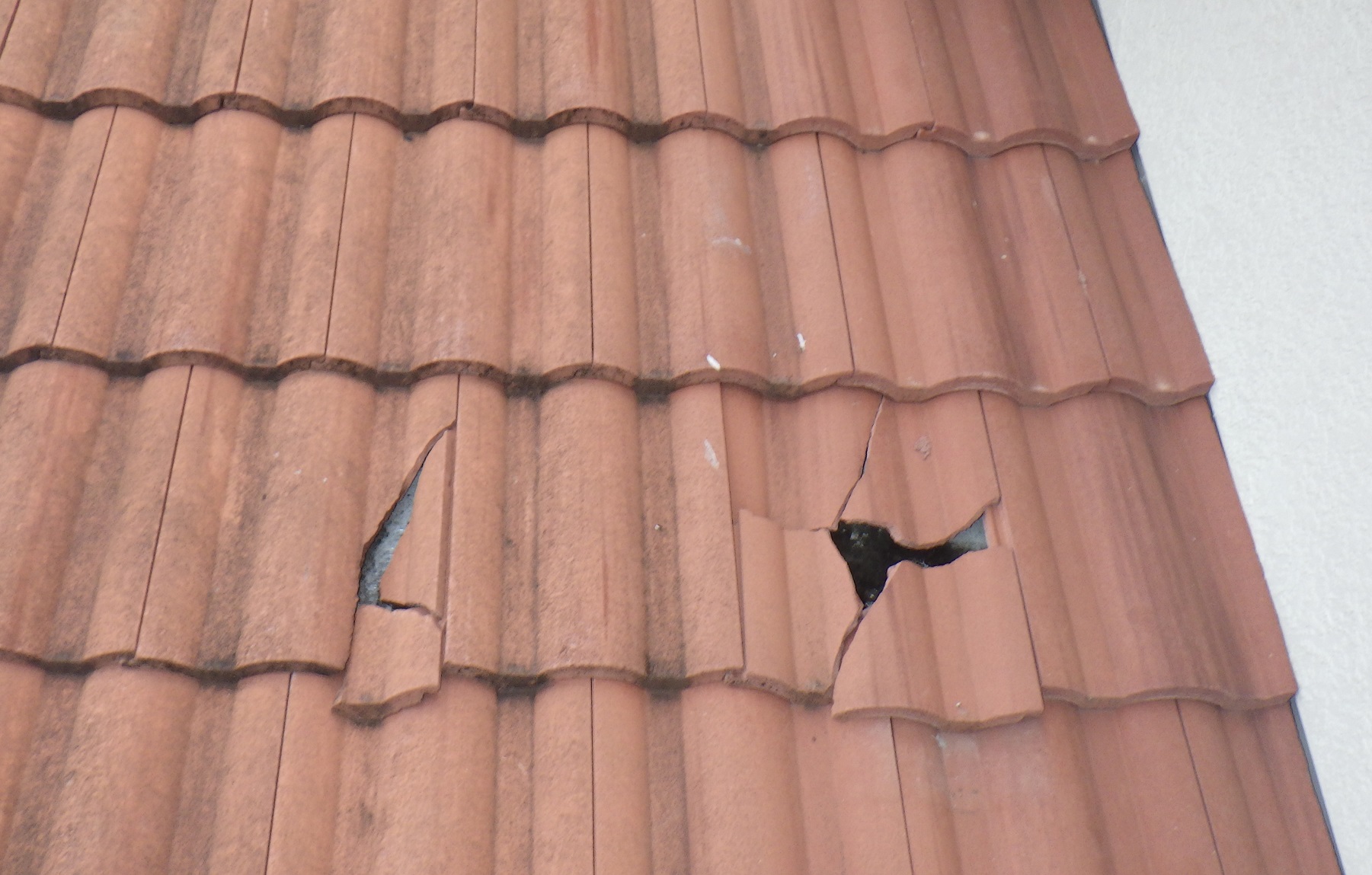
Broken Roofing Tile - Damaged Roofing Underlayment

Why Replace My Broken Roofing Tile?

Broken Roofing Tile - Damaged Roofing Underlayment

Broken roofing tile causes crack in tile roofing underlayment.

Broken roofing tile can cause problems to your roof eventually. It may appear that nothing is happening, but over time problems can pop up.

A roof leak can develop due to the ultraviolet rays now weathering your tile underlayment and developing cracks. Usually this takes place in a section of the tile roof that you can’t see. If it were right in the front where you walk all the time, then it is easier to see and react. This can happen regardless of the type of tile roofing system that is installed on the roof.

Broken roof tile can allow water to enter the tile roofing system (between the tile underlayment and roofing tile). If the tile roofing system was designed with edge returns on the flashings, then the roofing tiles themselves are an important part of the waterproofing.

If the tile roofing system is a sealed tile underlayment system with a foam or mortar tile roofing attachment, then it is not so critical that the broken roof tile not allow water to enter the system. This will still allow the ultraviolet rays to prematurely break down the tile underlayment. It takes a while, but just a couple of years passing by would let this happen. Ask yourself this, “How often do I really look up there?”

Broken Tile causes roof leak

Cracked all the way through the tile underlayment.

Having us do a once over at least once a year will alert you to any broken roofing tiles that you may have not seen. Counting the broken roofing tiles is something we do when we provide the once over service. Cleaning the gutters and checking over the roof is a good practice to keep your roof maintained.

Paying attention to the type of tile underlayment that is installed when you do the tile reroof will help keep the roof in tact when broken tiles exist. Most tile roofing underlayment is not designed to be exposed to the elements past 6 months. Some have a rating of “as soon as possible”. Most of the tile underlayments that are installed today are the self-adhered underlayments, designed to be under roofing tile. Some are thin and others are thick with extra protection from the elements. We like to install SA Cap as a tile underlayment so then the exposure time is not so critical. This is the same material that we use on flat roofing that is designed to be exposed to the elements without anything on top of it.

Palm frond breaks roofing tile

Broken roofing tiles from fallen palm fronds.

A really bad roof leak in Naples, FL

ROOF LEAK EMERGENCY!

So, we get a call from a frantic customer and they are not happy when we tell them it will be a few days before we can go look at the “worst roof leak ever” (customer’s words). Fortunately, we had an opening sooner than later and was able to meet with the customer’s contractor first thing in the morning, the very next day. All we got was that yesterday’s rain made it leak really bad and these kitchen cabinets are going to get ruined, unless we fix this roof leak now.

They were all set to have us do a huge roof repair, similar to one we did several years ago on the other side of the front entry. Now this problem is on the opposite side and “appears” to be what needs to be done. We were more than enthused, since that was a pretty big job, and let’s face it, we were in all the way.

Well, we are not easily swayed into action when our philosophy is to find out what the problem is first (if at all possible), and then fix it. Not the other way around. This is even when the carrot is right there where we can grab it. After all, the only reason we are there is because there is water pouring out of a can light in the kitchen. Otherwise, we would be somewhere else. So the question is, “Why?”

A really bad roof leak in Naples, FL

Water pouring out of can light in a Naples, FL kitchen after heavy rain.

So the story goes on…

After a few moments of despair and awkward conversation with the customer’s contractor, the roofer said “I need to get in the attic and see what the problem is!”

AC Pan full of water and Posing as Roof Leak in Naples, FL

AC Pan posing as roof leak

Notice the top side of the can light in the bottom center of the photo above.

So looking at the underside of the plywood roof decking in the attic, there was absolutely no evidence of any roof leak. The air condition overflow pan was full of water. This particular unit has a condensate line coming out of the machine and also a secondary line to drain the overflow pan underneath of the unit. Both of these lines were clogged and not draining. So every bit of water coming out of the unit was going into the kitchen.

Roof Repair Naples, FL

A/C pan full of water posing as a roof leak

Apparently, once it starts raining, the humidity level goes up and makes it even worse. This is why the customer associated the problem with the rain.

Either way, they got what they wanted, because now they are just minutes away from getting the water to stop pouring in. They turned off the air conditioning unit, and that alone is miles ahead of where they were yesterday. After the condensate lines are unclogged and flowing, they will at least not have water flooding the kitchen anymore.

Now it’s time to call the drywall company!

Believe it or not, this is a common call that we get. It is worth investigating, because we have had several cases where the roof was leaking and the A/C was also overflowing. Although, that scenario is very rare. Most of the time, water leaking from the ceiling is a roof leak. Either way, we will be sending a bill if we discover the air conditioning is the problem and the roof is not. There are a few questions that can be answered to investigate this issue, but that is for another time.

I think the reason I am writing this post is because the customer was set on having us repair the valley-cricket combo. A huge roof repair.

Is that Spot on the Ceiling an Active Roof Leak?

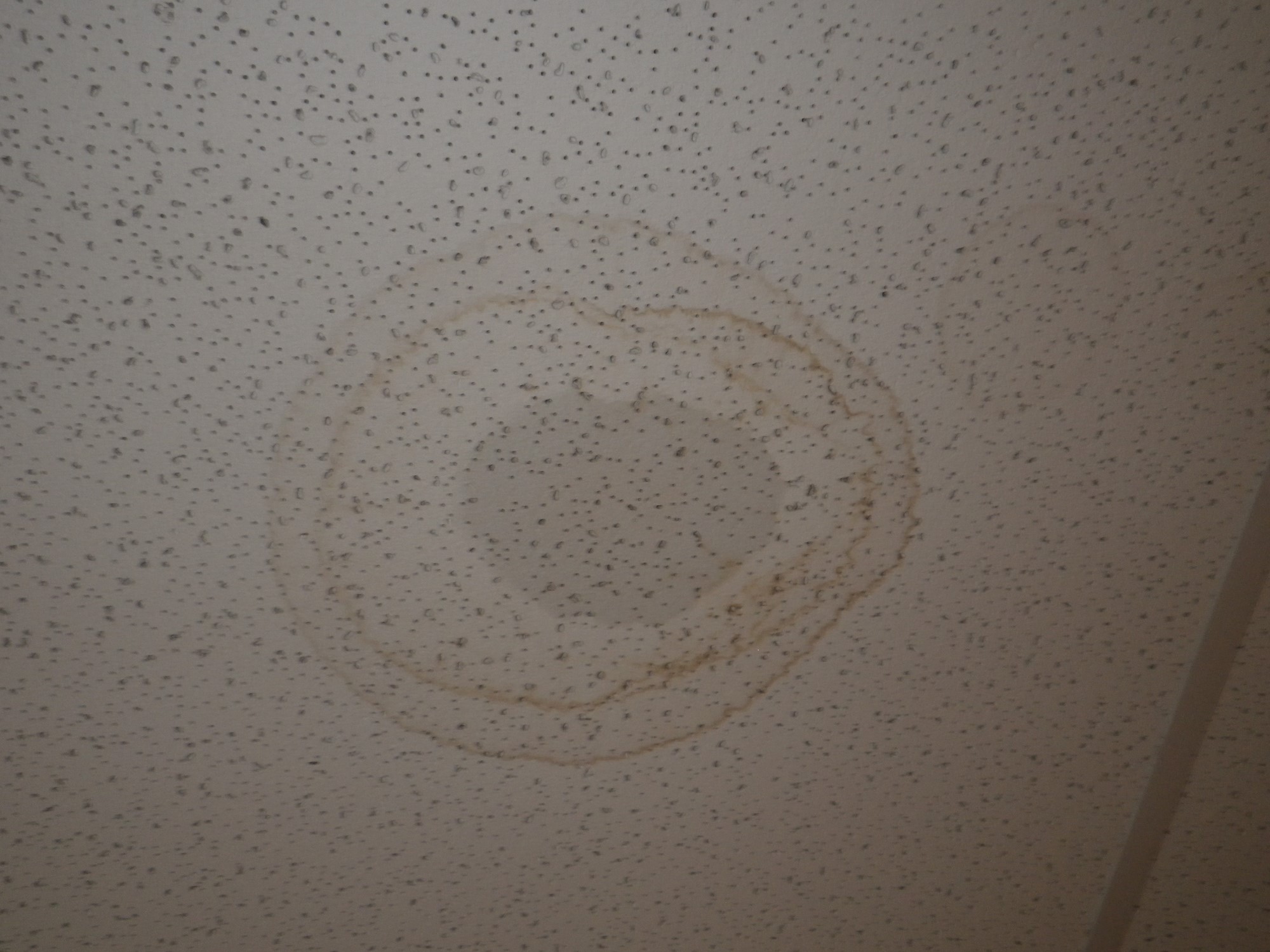
Roof Leaking? This spot on the ceiling tells a tale that this roof leak didn't just start yesterday.

Roof Leaking? This spot on the ceiling tells a tale that this roof leak didn’t just start yesterday.

Looking at this photo of a stain from a roof leak, it is telling. This photo is showing some brownish color rings with a darker gray color circle inside of them. The darker gray color is also more of a solid circle than the brownish rings. The darker gray color is actually wet to the touch and the brownish color rings are dry to the touch.

Looking at this photo, it is apparent that this leak did not just start and has had some time to create the brownish staining. Since there are several rings, it indicates that it has leaked and dried several times. The brown stain is particles in the water from its travels from the roof, then the deck, then the truss system or joists, the insulation, and then the topside of the ceiling board. In this case, the ceiling is a drop ceiling, which just means it is installed as a system on its own and not installed directly to the roof trusses or joists. This allows for mechanical and lighting items to be installed and serviced in between the ceiling and the roof.

Usually when there is brown staining, it means that the leak is dry or has been dry. It does not mean that there is not a roof leak, but can signify that there was a leak at one time.

Throughout a season, the stain may stay a brownish color until such time the roof leaks in sufficiently to allow the water to make it all the way to the ceiling and show itself. This is when it will turn the darker gray color and signify that it is wet, this would mean that the roof leak is active.

We have run into many situations where there are stains on the ceiling from previous roof leaks and the client will ask, “Is that leak active?” Typically this is a new owner that does not know the history of the home or building. The response is always the same, “Not sure, we will have to wait for rain or water test!” The current or past occupant of the home or building is the person to ask, because they are the person that would be around when it rained to see if the spot turned that darker gray color. If an entire summer season passes and the brownish color stain never changes, then it is probably safe to say that the roof leak is not active.

This is a generalization and does not represent all situations, but is geared towards explaining what color the stain is when it did leak from that heavy rain we got last night. Now this wet area may only last a day or so after the rain stops and then it is back to the way it looked before.

5V Metal Roofing Screw Backed Out

5V Metal Roofing Maintenance

5V Metal Roofing MaintenanceOwning a home or commercial building with 5V metal roofing is a common occurrence in Southwest Florida. Metal Roofing is not without periodic maintenance. After about 10 years in the Southwest Florida sun, the metal roofing panels will need to be gone over. The expansion and contraction over time causes the system to loosen up. The screws or fasteners will have backed out or even become loose. We can go in and touch every screw. If it tightens, we pass. If it does not tighten, we install a new oversized screw in its place. We can also add a dab of sealant to any suspect screws.

5V Metal Roofing Screw Backed Out

The photos show a painted 5V metal roof system. The color is Forest Green, which is the darker green. The roof is approximately 17 years old, at this time. We were cleaning out the gutters and alerted the customer about the loose screws. Loose screws in a 5V metal roofing system can cause roof leaks, if left alone long enough. We went over this entire roof in less than a days time and now it is good to go for another couple of years.

This process should be performed periodically and can be done without physically seeing screws that have backed out. This is one of the benefits of having Sunshine Roofing clean the gutters, as it gets eyes on the roof to see things that need to be done. This periodic maintenance could be the difference between a 15 year roof and a 30 year roof.

Loose Screws in Metal Roofing


The wind resistance of a metal roof is severly diminished when the screws are loose. Once the wind penetrates one area, the whole system becomes vulnerable. General periodic maintenance will reduce the chance of any wind uplift issues.


Metal Roofing Plastic Boot

Another item that needs to be checked is the plumbing stack boots. We got away from using lead boots on metal roofs, due to the corrosion that would happen on dissimilar metals. Now we use plastic and neoprene boots. The plastic boots will only last so long and will start to deteriorate. If it is caught early, caulking can be applied to seal the pipe. Once it goes so far, replacement is the only option. Most of the time, a roof leak is how a crack in the plastic metal roofing boot is discovered.

Neoprene Boot - Metal Roofing

The neoprene metal roofing boot is installed on top of the panels, instead of creating a seam. There are seals underneath that work together with sealant and screwed directly to the metal panels. Then there is a tight fit around the pipe with the neoprene itself. These boots get loose over time and have been known to split.

This photo shows an example on a standing seam metal roofing system, but is installed in much the same way on 5V metal roofing.

Again, the metal roofing boots are an item of concern when maintaining your metal roofing system.

Cleaning the gutters, maintaining the fasteners, and checking all penetrations will keep your metal roofing system in great shape. Let Sunshine Roofing of SW FL, Inc. handle this task. We have many regular customers we take care of on a regular basis.

New Tile Roofing Remodel -Bonita Springs, FL – Pelican Landing

Recently completed Concrete Roofing Tile

Recently completed Concrete Roofing Tile

Sunshine Roofing of SW FL, Inc. recently completed another concrete tile roofing addition in the Pelican Landing community in Bonita Springs, FL. This particular job was one where the existing roofing tile is not manufactured anymore.

With some hands on research we were able to tie in the new roofing tile to the existing roofing tile on the side of the home shown in the photo. You can see in the photo the line where the existing roofing tiles and the new roofing tiles meet. The color is pretty close. This is the only option (short of re-roofing the entire roof), because the existing roofing tiles are no longer available for purchase from the manufacturer. We salvaged as many of the existing roofing tiles as we could from the roof where the addition was built on to. Once the roof is cleaned the roofing tiles should be pretty close in color and it would take some effort to see the line.

The existing roof is approximately 12 years old at this time. Now that the addition is complete, they should have another 10-15 years before they need to worry about re-roofing.

Smaller roofing jobs that need a little more hands on attention is where Sunshine Roofing shines!

Ryan Testimonial – Recommending Sunshine Roofing to Neighbors

Ref: Recent Roof Tile repair   6/5/2014

To: Management of Sunshine Roofing:

Your co. recently replaced broken roof tiles on our home and also cleaned our roof-gutters!

This far, we are very satisfied with the job completed! The employees did a very clean job and also were prompt on arrival, very professional!

We really appreciated Dave’s video of our roof, which showed all the tile problems and damage. We will not hesitate in recommending Sunshine Roofing to neighbors and friends (we already did).

Thank you,

B and M Ryan

We will not hesitate in recommending Sunshine Roofing to neighbors and friends (we already did).

Roof Coating Process

Roof Coating – A Different Approach

Often times we will get the reaction of surprise when we quote a roof coating job. This is a result of the popular mind set of “Don’t you just roll the roof coating on? I can do that for a lot less than this!”. Well, yes! After we clean it, clean it, clean it, repair areas that are suspect. Then apply a bed coat, sometimes with fabric. Then come back and clean it again, to apply another coat. Then possibly come back for a 3rd trip to coat again. Each time, of course, with some prep work. We also use premium products. Which means that we will do our very best to follow manufacturer recommendations.Roof Coating Process

The main roof coating system that we do is a system where we embed polyester fabric on all the seams of the existing roof covering into the coating. This is called a roof restoration. It is called this because we are taking an existing roof (preferably in good condition) and restoring it with a coating and also reinforcing the seams of the existing roof covering. The photo to the left is of a roof we “repaired”. You can see the roof coating is only in specific areas. There is a reason behind it.

Roof Coatings Need to Be Looked After

The following video highlights a roof coating “repair” we did on a roof that we had previously coated one year earlier. We were expecting that the coating we applied would take on some ponding water. We followed the manufacturer recommendations regarding the roof coating restoration system, but somehow we still fell a little short. We had provided some periodic maintenance to some other coating jobs we had done before this one and found the areas where there was ponding water had deteriorated. Since we were using a premium system, we really didn’t like what we saw. So, of course, we fixed it. We applied the same process that you will see in the video to the places the roof coating really needed it. So when we then went to this job to clean off the leaves and debris and check that the scuppers were clear, we discovered that the same thing was happening to this roof coating as well. So I contacted the owner and explained that I wanted to make sure and repair the roof coating now, before we had any breakdown in the material similar to what we experienced in the other jobs. We did not charge any extra for this, as it was not the owners fault. We just needed to chalk this one up to experience. That is what you get when you hire Sunshine Roofing of SW FL, a little more.

Standing Seam Metal Roofing

Standing Seam Metal Roofing – North Naples, FL

Recently we completed a reroof of a home in North Naples, FL. This home had an asphalt shingle roof on it before. The homeowner asked for an alternate quote for standing seam metal. After some debate and questions about the metal roofing, they decided to go for it. This is the old roof before we replaced it with a new metal roof.

New Metal Roofing Naples, FL

Existing Shingle Roof in North Naples, FL

Standing Seam Metal Roofing

Standing Seam Metal Roofing – Finished Roof.


Complete Tear Off of the Old Roofing

Metal Roofing Tear off Shingles

Tear off the old Shingle Roof down to the plywood

We completely tore off the old asphalt shingles and tarpaper. Then pulled all the nails and got the deck cleaned up. Very minor wood repair was needed.


Once the deck was cleaned off, we nailed off the existing plywood with 8d ring-shanked nails 6″ apart on all the trusses, this is required by the Florida Building Code, and is an upgrade on the wind mitigation inspection.

Re-nailing plywood for new metal roofing

Re-nailing the plywood per Florida Building Code and wind mitigation upgrade.

Once this was finished we applied a self adhered underlayment for metal roofing. This material is required for the secondary water resistance in the Florida Building Code, and is also an upgrade for the wind mitigation inspection.  Now the roof is completely dried in and ready for metal.

New Standing Seam Metal Roofing

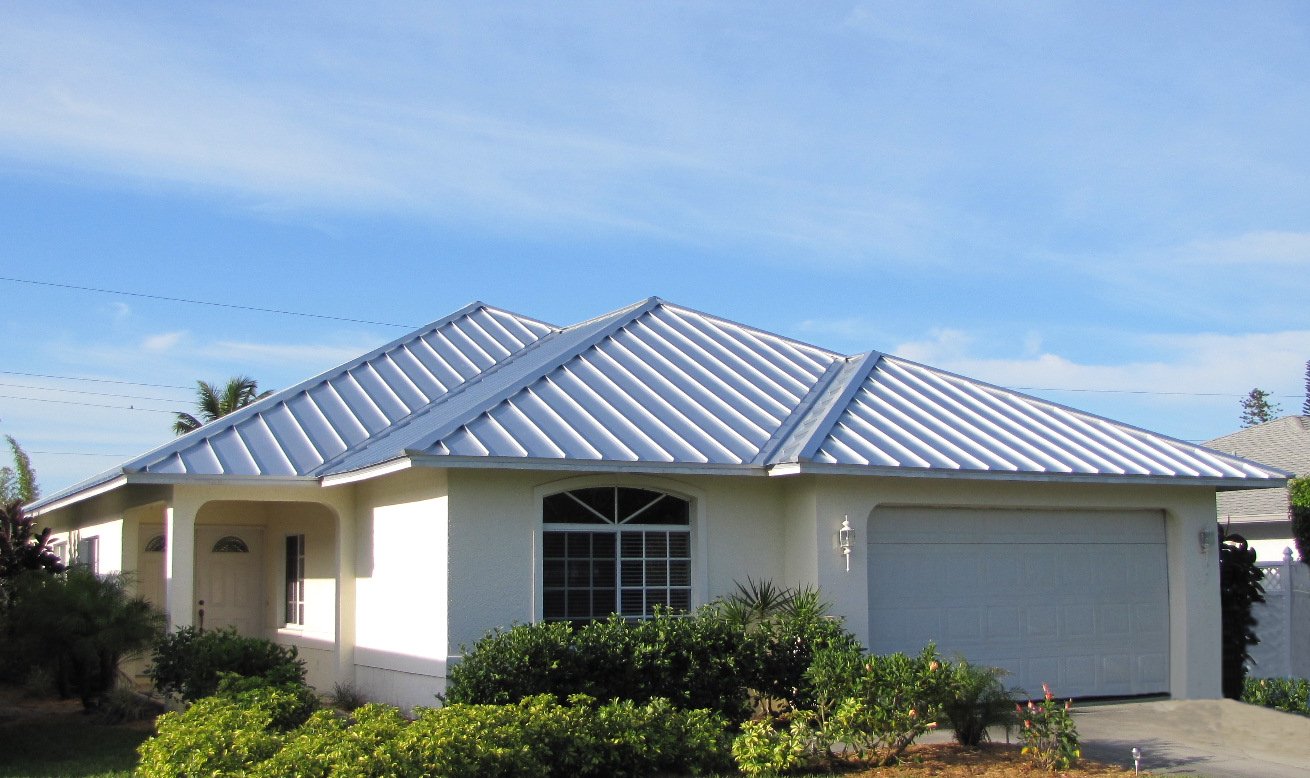
The new metal roofing system material is 24 guage galvalume, mill finish. This is a premium metal roofing material. The standard or minimum is 26 gauge, which is thinner than 24 guage. Mill finish is the natural color of the metal, which is silver. The metal roofing panels are custom fabricated to length so there are a limited number of seams. The metal roofing panels are a snap-lock system.

Standing Seam Metal Roofing Naples, FL

Clips on one side and a “snap and lock” on the other.


This means we apply a clip to one side of the panel 16″ apart, and the other side of the panel “snaps and locks” onto the previous panel. This roof has no horizontal seams due to limited penetrations. This home only has 1 plumbing stack on it, so we did not have any panels to split. The longest panel runs on this home were 25′.


The fasteners for the panels are not visible, as they are covered by the next panel. The bottom of the panel is bent over the dripedge. This creates a cleat for the standing seam metal roofing panels to grab on to and limits the system from catching the wind. Once all the panels are installed, the hip and ridge flashings are then installed. A series of “z” flashings are fastened in place to accept the hip and ridge and compensate for the seams or standing seams of the metal. The hip and ridge flashings are fastened to the “z” flashings with rivets. These rivets are not readily visible. Once everything is in place, the new standing seam metal roofing system is a great upgrade to any home.

Standing Seam Metal Roofing Naples, FL

Standing Seam Metal Roofing – Finished Roof.

Roofing Quote Comparison

Roofing Quote – Why It is Not Based On Homes Square Footage?

There are several reasons why you can’t get an accurate roofing quote based on your homes square footage. Also, there is the reluctance on the part of the roofing company to give out this “number” without getting more information. It isn’t because the roofing contractor doesn’t know what they are doing. It is usually because the caller does not know the process or what is all involved in coming up with a roofing quote. It just sounds so simple.

Roofing Quote Footage is Not the Same as Home Square Footage

Depending on where the information is coming from is going to determine the basis on which the estimated roof footage is calculated. The roof square footage is what we (roofing contractor) need to calculate a budget quote to do the job. So when you say my home is 1,500 square feet, how much to do the roof? Well, that is a good question. Does that amount include the garage? Does it include the back covered lanai area that is encompassed in the main portion of the roof? Does it include the addition that was built last year? Does it include the 2 – 4′ overhang or soffit area? Does it include the front entry? All these things could add much square footage to that 1,500 sq. ft. number. It also does not encompass all that is needed to come up with the square footage of the actual roof. This does not automatically mean the roof is 15 squares, as some might lead you to believe.

Types of Roofing Quote Material

From asphalt shingles, flat roofing, metal roofing, and concrete tile roofing, there are a myriad of pricing differences and waste factors that go into each individual price structure of a project for each different product. Not limited to slope of roof, hip footage, ridge footage, valley footage, edge footage, field footage,  access, number of stories, and job location all have to do with it. Usually we can get an idea just knowing the roof field footage and the slope, but it is not something that is across the board, at least not for us. There are some companies that have set per square foot pricing, but we have not found this to be efficient. If we paid our guys the same on an easy up and over roof that we did on a cut up and steep one, do you think the workmanship will be the same? I don’t think so, and the latter is the one that needs the excellent workmanship just to survive.

Square Footage Information Changes Depending on the Source

The real estate listing has a home square footage number, but no basis on what this represents. The property appraiser has a square footage number, but they are only looking at your property tax liability. You have a number in your mind from when you bought the home, or a round-a-bout number that you may have used in other projects, but is this number even accurate? The numbers you have may only be air conditioned space, because isn’t that what is most important?

Here are two examples of the square footage from different sources – They don’t match up for the roofing quote

Roofing Quote Example 1

3 bedroom 2 bath home – MLS Listing has a square footage of 1,149. The county appraiser has the Actual square footage at 1,701 and adjusted square footage at 1,450 (they adjust the square footage so you pay a lesser amount of tax for lanai or garage, as you do for living space). Now the roof measures approximately 2,006 with a 5:12 slope for a total of 2,176 square feet plus a waste factor (depending on what type of roof covering) for the roofing quote. So the stats for this one are 1,149 sq.ft. MLS, 1,701 sq.ft. county appraiser, and 2,006 sq. ft. roof measurement. This is way too much of a difference to come to any reasonable conclusion.

Roofing Quote Comparison

Example 1

Roofing Quote Example 2

3 bedroom 2 bath home (2 story) – MLS Listing has a square footage of 1,670. The county appraiser has the Actual square footage at 1,746 and adjusted square footage at 1,484. Now the roof measures 1,519 with a 10:12 slope for a total of 1,978 square feet plus a waste factor (depending on what type of roof covering) for the roofing quote. So the stats for this one are 1,670 sq.ft. MLS, 1,746 sq.ft. county appraiser, and 1,978 sq.ft. roof measurement. A lot closer than example one, but still inconsistent. Also, now we have the 10:12 slope to factor in as it will be more labor for the steeper slope.

Roofing Quote Comparison

Example 2

Get a Budget Roofing Quote That Means Something!

So now when you call your favorite roofing service provider, you can ask them to give you a budget quote based on an internet measurement. When the roofing company starts asking those nosy questions like what is the address? How many stories is this home? What kind of roof are you wanting to put back? Are you the current owner? You will know why they are asking. Some roofing companies use pay services to get satellite takeoffs for their roofing quote, and they are very detailed. For homes that are just looking for a number, this is just not cost efficient for the roofer. They are usually more cost efficient for the very large homes and commercial type properties.